Poured in the Dark: Inside Britain's Underground Concrete Revolution
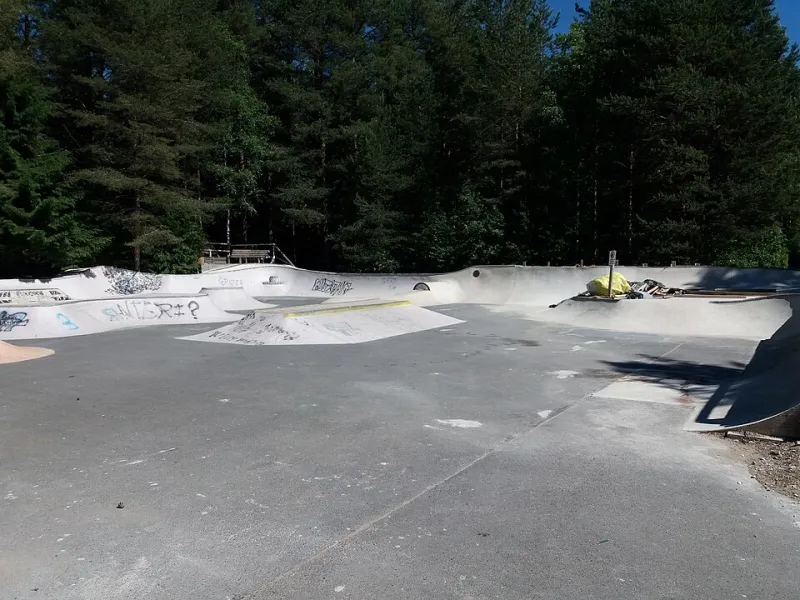
Photo: Mikko J. Putkonen (Methem), CC BY 4.0, via Wikimedia Commons
There's a spot in the Midlands — we're not telling you where — where an underpass that used to be a wind tunnel of wet leaves and shopping trolleys now houses a quarter pipe so smooth you'd swear it was machine-made. It was not. It was mixed in a wheelbarrow by three lads in hoodies at roughly 2am on a Tuesday.
This is the DIY skate scene, and if you've only skated council parks, you've been skating the demo version.
How a Hole Becomes a Heaven
Every DIY spot starts the same way: someone finds a slab of forgotten public infrastructure and thinks, that'd be a good bank. Then the WhatsApp group forms. Then somebody's uncle happens to work in construction. Then, one weekend, twenty bags of postcrete vanish from various retail parks across the county and a plinth appears.
The crews we spoke to describe a strange inverted logic to their work. Council skateparks get designed by consultants and built by contractors who've never pushed a board. DIY spots get built by the people who'll skate them daily, which is why the transitions are right, the coping is where it should be, and the flat ground between obstacles actually flows.
One crew member from a northern city — call him Gaz, because that's what he asked us to call him — put it plainly: "The council spent £180k on a park with a flat bank too mellow to ollie off. We spent £400 on readymix and built something better under a flyover. Guess which one's busier."
The Legal Grey Area (It's Very Grey)
Here's where it gets murky. Technically, pouring concrete on public land without permission is criminal damage. Practically, enforcement is patchy, and many councils have quietly concluded that a well-built DIY spot is cheaper than the antisocial behaviour it displaces.
Some authorities have gone further. A handful of councils — and yes, we've checked, and no, we're not naming names — have started doing something remarkable: nothing. Spots that would've been bulldozed a decade ago are being left alone, sometimes for years. A couple have allegedly even offered materials after the fact, in that very British way of supporting something while maintaining plausible deniability.
Others take the old approach. A crew in the South East had a spot demolished three times in eighteen months. They rebuilt it three times. The fourth version got a drainage channel because the council's own surveyors flagged the waterlogging. Read that sentence again.
Why Council Estates Build Better Parks
There's an uncomfortable truth underneath all of this: the best skateboarding infrastructure in Britain was built by teenagers with no budget, no permission and no insurance. The spots that last are the ones with local ownership — crews who sweep them, patch them, and quietly discourage the one guy who keeps tagging over the coping.
Compare that to the council park model: build it, sign it, forget it. Within two years the surface is cracked, the metal edges are bent, and the only people there are on e-scooters.
The estate-born DIY spots work because they're not facilities. They're projects. Someone's mum knows about them. Someone's dad delivered the cement. There's a stake that no procurement process can replicate.
The Truce, Quietly Emerging
The smartest councils have worked out the maths. A DIY spot costs them nothing to build, roughly nothing to maintain, and gives a visible, self-policing community use to spaces that would otherwise host stolen mopeds. The demolition crews cost more than the concrete ever did.
So the next time you roll up on a spot that's too good to be true — buttery coping, perfect drainage, a handrail that actually kinks where it should — take a second. Somebody mixed that at midnight. Somebody's been back every fortnight to patch it. Somebody risked a charge sheet so you could have a line.
Sweep the pebbles off the flat. Put the trolley back. And if you see a crew pouring at 2am, maybe give them a hand. That's how the best parks in Britain get built.